How to Find Hidden Cat and Dog Urine with a UV Black Light
Smell Pet Urine but Can’t Find It? A UV Light Can Help!

You know that smell. Cat urine or dog urine is somewhere in your home, but you can’t figure out where it’s coming from!
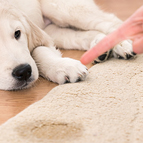
Maybe your cat had an accident behind the furniture. Perhaps your dog urinated on the carpet, and the stain has already dried. Or maybe you’ve moved into a home where previous pets left behind odors you can’t locate.
A UV black light can help you find hidden pet urine stains on carpet, furniture, floors, baseboards, and other surfaces—even when the stains are difficult to see in regular lighting.
Once you’ve located the urine, OdorXit Eliminator helps eliminate the odor at its source instead of covering it up with added fragrances.
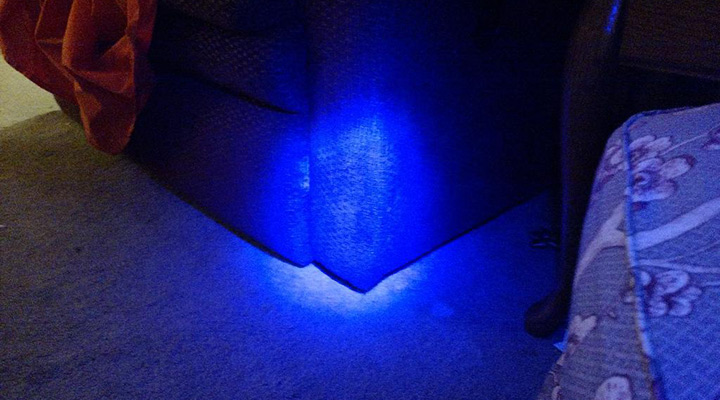
A UV black light works best when the room is dark.
You don’t necessarily have to turn off every light, but reducing the amount of visible light will make fluorescent stains easier to see.
Close curtains or blinds to block outside light and block sunshine.
Wait until evening if the room is still too bright.
Turn on your UV flashlight.
The darker the room, the easier it may be to spot fluorescent urine residue.
Hold the UV flashlight close enough to illuminate the surface and slowly move it across areas where you suspect pet accidents.
Pay special attention to:
Don’t just look down! Cats sometimes spray vertically onto walls, furniture, and other objects. They also sit on furniture and pee, so there may be drip marks from 3 to 5 feet up the wall.
Move slowly so you don’t miss small stains or scattered droplets.
Some dried urine residues may glow yellowish, greenish, or whitish under a UV black light.
You might notice small spots, splatters, streaks, or larger patches where urine has soaked into the material.
Important: Not every urine stain will glow under UV light. Visibility depends on the type of UV light, what the furry perpetrator has eaten, whether the surface has already been cleaned, the age of the stain, and other factors.
Also, urine isn’t the only substance that fluoresces. Cleaning products, detergents, food spills, and other residues may glow too.
A glowing spot is a clue—not absolute proof that you’ve found urine.
Use the location, appearance, and odor to help determine whether the area needs treatment.
Once you’ve identified a suspicious area, mark its location so you can find it again when the lights are on.
You can use a small piece of removable tape near the stain or take a picture for reference.
Check beyond the visible spot.
Urine often spreads farther underneath carpet and upholstery than it does on the surface.
That’s why a small stain may cause a much larger odor problem.
Finding the urine is only half the job. Now you need to eliminate the odor!
OdorXit Eliminator is a dog urine odor eliminator and cat urine odor eliminator made with essential oils and water, with no enzymes or added fragrances.
It targets stubborn pet odors at their source instead of covering them up with perfumes.
For regular odor elimination, use OdorXit Eliminator Ready-to-Use or prepare Eliminator Concentrate according to the product directions.
Mix 1 ounce of OdorXit Eliminator Concentrate with 32 ounces of water.
Or mix 4 ounces of Concentrate with enough water to make 1 gallon (128 ounces).
Adding a carpet shampoo containing surfactants can help the solution spread and penetrate porous materials, allowing OdorXit Eliminator to reach urine that has soaked below the surface.
For one gallon, mix:
We’ve found that Walmart Great Value Carpet Shampoo with dogs pictured on the label has consistently contained surfactants. Always check the current label to confirm the ingredients.
If the urine soaked through, OdorXit needs to reach there too.
For carpet, that may mean reaching the backing and padding and sometimes the floor beneath. For upholstery, it may mean reaching the cushion beneath the fabric.
Use enough solution to reach the urine-contaminated material without unnecessarily flooding the surrounding area. Test delicate materials in an inconspicuous spot first.
On hardwood floors and other moisture-sensitive surfaces, avoid excessive liquid and follow the appropriate surface-specific instructions. In 99.9% of cases, the Eliminator will not damage your flooring.
Never mix OdorXit Eliminator with chlorine or bleach products.
For detailed treatment instructions, visit our guides for removing urine odors from carpet, furniture, concrete, and other surfaces.
Don’t give up! It’s time to get down and dirty!
Put on the best pair of knee pads you can buy, get down on your hands and knees, and start crawling around the area, using your nose to track down the odor.
Yes, it’s probably the most hated part of the process, but getting down close to the surface and sniffing is often the best way to pinpoint exactly where that stubborn urine odor is coming from!
Here’s where to sniff and look:
Remember: Just because you can’t see urine under a UV light doesn’t mean it isn’t there!
Your nose may find what your UV flashlight missed.
Once you’ve located the source, Don’t Just Mist It. Saturate It. On water-safe, absorbent materials, OdorXit Eliminator needs to reach wherever the urine traveled to eliminate the odor at its source.
The UV light helps you find the problem. OdorXit Eliminator helps you eliminate it.
Rather than spraying an entire room and hoping you’ve treated the right area, a UV flashlight can help you focus on the places that need attention.
The OdorXit Starter Kit makes it easy to get started. It includes:
Find the urine. Treat the source. Eliminate the odor.
3729 Riva Ridge Dr
Hamilton, OH 45011


 Shop OdorXit UV Light & Starter Kit